




AO
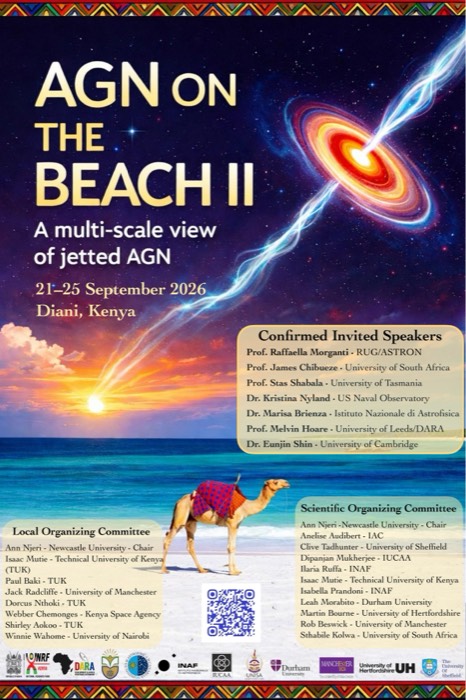
AGN on the Beach II
While relativistic jets are well-established agents of feedback in active galactic nuclei (AGN), compact radio outflows (jets or winds) are also thought to play a key role in driving galaxy evolution. However, their exact impact remains uncertain and is the subject of ongoing discussion. Recent observational progresses (e.g. high-resolution radio and mm interferometry, IFU spectroscopy, sensitive low-frequency imaging) and advances in hydrodynamical simulations have shown that even low-power or small-scale jets on (sub-)kpc scales can strongly perturb the surrounding interstellar medium (ISM), driving shocks and turbulence, and altering the star formation locally. Nevertheless, we still lack a coherent, multi-scale picture linking (i) the physics of SMBH accretion and jet launching at sub-parsec scales, (ii) the resulting radio morphologies on pc–kpc scales, and (iii) the net impact on galaxy evolution across environments and cosmic time.
This workshop will concentrate on the critical open questions in accretion vs ejection mechanisms highlighted recently by observational and theoretical studies: what primarily sets radio morphology (central engine vs environment vs age); whether the classical radio-loud/radio-quiet dichotomy maps to distinct physical modes or a continuum; how transitions between radiatively efficient and inefficient accretion manifest observationally; and what fraction of low-luminosity/compact radio sources actually host jets energetic enough to affect their hosts.
By bringing together observers working with latest-generation radio and mm facilities (e.g. VLBI, e-MERLIN, MeerKAT, LOFAR, JVLA, ALMA, MUSE, JWST, etc.) and simulators modelling jet–ISM coupling, this meeting aims to convert recent fragmented results into a clear roadmap for future multi-wavelength observational campaigns and theoretical benchmarks. In particular, in this meeting, we aim to address the following scientific topics:
- What are the main factors that determine the morphologies of radio jets?
- How do we differentiate between outflows driven by accretion disc winds and small-scale jets?
- How do jets (or feedback in general) couple on different scales, and what impact does this have on galaxy evolution/the environment?
- What is the nature of the low-luminosity/compact radio-AGN (P₁.₄ < 10²⁴ W Hz⁻¹)?
- What are they? How do they interact with the surrounding environment? Can they provide feedback?
Meeting format
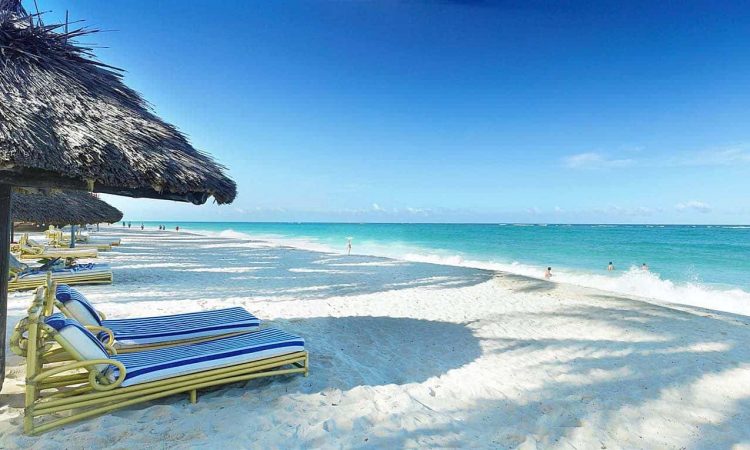
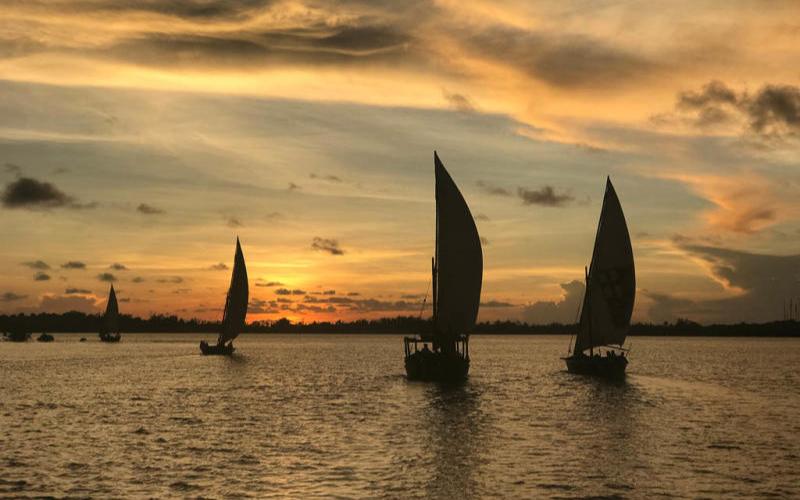
The workshop will take place in the wonderful location of Diani, located about 50km South of Mombasa (Kenya). We plan four full days and one half-day of scientific presentations and discussions. We aim to alternate some long lunch breaks with short afternoons to allow you to relax, discuss, and explore the beautiful location with your colleagues. A range of social activities will also be offered. More details to follow soon.
Where it’s happening

Venue
Diamonds Leisure Beach and Golf Resort
Diamonds Leisure Beach & Golf Resort, Coast, Kwale, Kenya